
Labotemp Rotary Microtome is a precision microtome machine designed for accurate and repeatable tissue sectioning in histopathology, diagnostic, and research laboratories. Built on a stable rotary feed mechanism, a rotary microtome produces uniform thin sections with controlled cut thickness ranging from 0.25–0.5 µm up to 100 µm, depending on the model, supporting reliable serial sections for routine histology and consistent sample preparation. Labotemp’s range of rotary microtomes includes manual, semi-automatic, and full-automatic systems featuring precise horizontal specimen feed (20–28 mm), vertical specimen stroke (52–70 mm), automated specimen retraction up to 100 µm, adjustable cutting speeds, and full 360° specimen rotation for accurate orientation. Rigid microtome blade holders support standard disposable microtome blades and steel microtome knives, maintaining a stable cutting edge to deliver dependable quality sections for daily laboratory microtomy and downstream microscopy workflows.
Section Thickness Setting Range
Section Thickness Setting
Minimum Sectioning Thickness
Trimming Section Thickness Range
Germany Stepper Motor

Section Thickness Range : 0.5–100 µm
Section Thickness Setting : 0.5–2 µm in 0.5 µm increment; 2–10 µm in 1 µm increment; 10–20 µm in 2 µm increment; 20–50 µm in 5 µm increment; 50–100 µm in 10 µm increment
Trimming Section Thickness Range : 5–500 µm (600 / 999 µm is optional customization)
Horizontal Specimen Stroke : 20 mm (28 mm is optional customization)
Advanced Full-Automatic
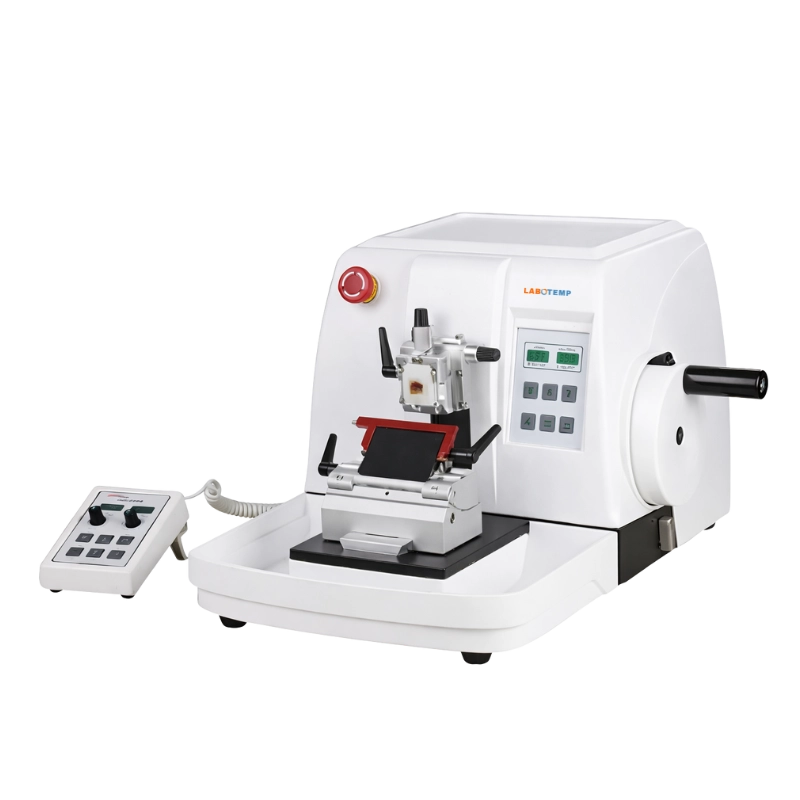
Section Thickness Setting Range : 0.25–100 µm
Minimum Sectioning Thickness : 0.25 µm
Trimming Thickness Setting Range : 1–60 µm
Specimen Retraction Setting Range : 0–50 µm (0 is off); 10–25 µm, 5–50 µm optional
360° specimen rotation

Section Thickness Setting Range : 0–60 µm
Trimming Thickness Setting Range : 0–60 µm (Adjustable)
Minimum Sectioning Thickness : 1 µm
Precision and Error : ±1%
Manual Microtome

Section Thickness Range : 0–60 µm
Section Thickness Setting : 0–2 µm in 0.5 µm increments; 2–10 µm in 1 µm increments; 10–20 µm in 2 µm increments; 20–60 µm in 5 µm increments
Horizontal Specimen Stroke : 0–28 mm
Vertical Specimen Stroke : 52 mm
1 µm precision
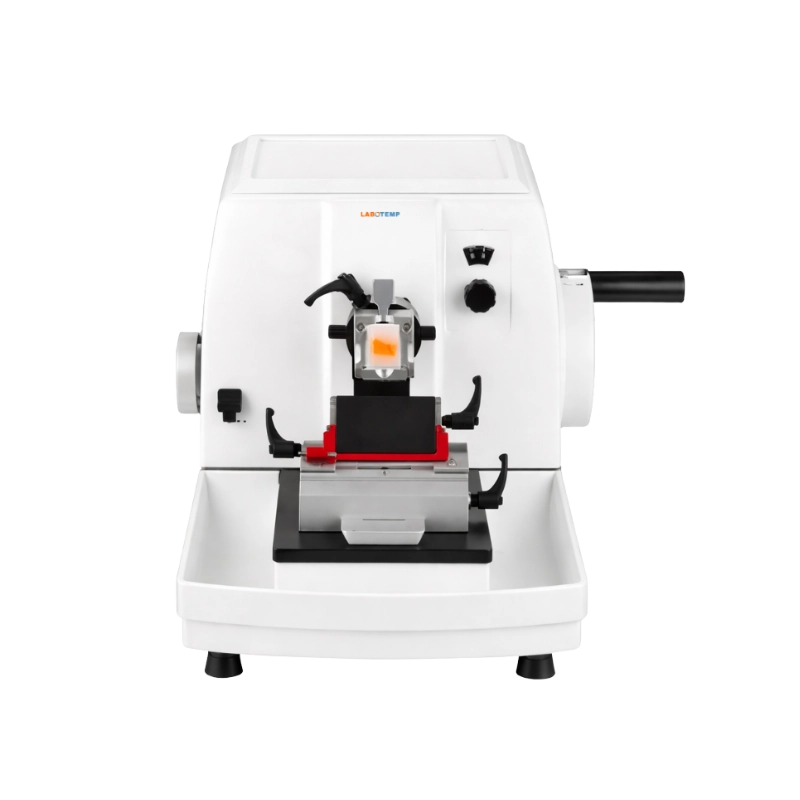
Section Thickness Setting Range : 0–60 µm
Section Thickness Setting : 0–20 µm in 1 µm increment; 20–60 µm in 5 µm increment
Trimming Thickness Setting Range : 0–60 µm
Minimum Sectioning Thickness : 1 µm
Touchscreen control

Section Thickness Setting Range : 0–99.9 µm, increment 0.1 µm
Trimming Thickness Setting : 0–999 µm, increment 0.1 µm
Specimen Retraction : 0–100 µm (can close)
Precision and Error : ±1%
Emergency Braking System

Section Thickness Range : 0.5–100 µm
Setting Values : 0.5–2 µm in 0.5 µm increment
2–10 µm in 1 µm increment
10–20 µm in 2 µm increment
20–50 µm in 5 µm increment
50–100 µm in 10 µm increment
Trimming Section Thickness Range : 5–500 µm (600 µm optional)
5–10 µm in 1 µm increment
10–100 µm in 10 µm increment
100–200 µm in 20 µm increment
200–500 µm in 50 µm increment
Horizontal Specimen Stroke : 20 mm (28 mm optional)
It's the level of automation. Manual rotary microtome models (ROM-03, ROM-04, ROM-05) use the handwheel for both trimming and cutting — simplest and most economical. Semi-automatic microtome models (ROM-06, ROM-07) add motorized feed and electronic controls (touchscreen/OLED) but you still cut by handwheel. Fully automatic microtome models (ROM-01, ROM-02) motorize the cutting itself with programmable speeds, automatic retraction, and remote-control operation for high-volume labs.
Yes. The automatic ROM-02 supports both automatic and manual sectioning on a single unit (sharing one power cord), so you can switch to the handwheel for fine control — or keep working during a power interruption.
From 0.25 µm to 100 µm depending on the model — the ROM-02 reaches the finest 0.25 µm, while routine paraffin work (3–5 µm) is covered by every model. Coarse trimming goes up to 500 µm (600/999 µm optional).
You need a cryostat. A rotary microtome cuts room-temperature paraffin or resin blocks; frozen tissue must be cut inside a temperature-controlled chamber, which is what a cryostat provides. Use a rotary microtome for paraffin histology and a cryostat for frozen or intraoperative sections.
Both. Every model ships with a 2-in-1 blade holder that takes standard low-profile and high-profile disposable blades, with lateral blade displacement so you can use the full cutting edge. Steel knives are supported on models that specify them, for resin or harder specimens.
Retraction pulls the block a few microns clear of the blade on the up-stroke, protecting the section and blade and producing cleaner serial ribbons. It's automatic on the full-auto models (ROM-02: 0–50 µm), adjustable on semi-auto (ROM-06: 0–100 µm, ROM-07: up to 220 µm), and optional on some manual models. It's worth having for serial, thin, or high-volume sectioning; optional for occasional single cuts.
All models include safety locks on the handwheel, a blade safety guard, and a blade ejector for safe blade removal, plus a removable antistatic waste tray. Automatic models (e.g., ROM-02) add an electronic safety brake with a removable handle; manual models use mechanical handwheel locks.
Every Labotemp rotary microtome includes a 1 year manufacturer's warranty against defects, backed by technical support and genuine spare parts; extended warranty and options are available on request.
Prices run roughly from $6,235 for the entry manual model (ROM-04) up to $14,243 for the advanced full-automatic ROM-02, with semi-automatic models in between. Automation level and features drive the price.
Yes — we ship internationally, and with express shipping your rotary microtome is delivered within 15–18 days, complete with secure export packing and shipping documentation.
