
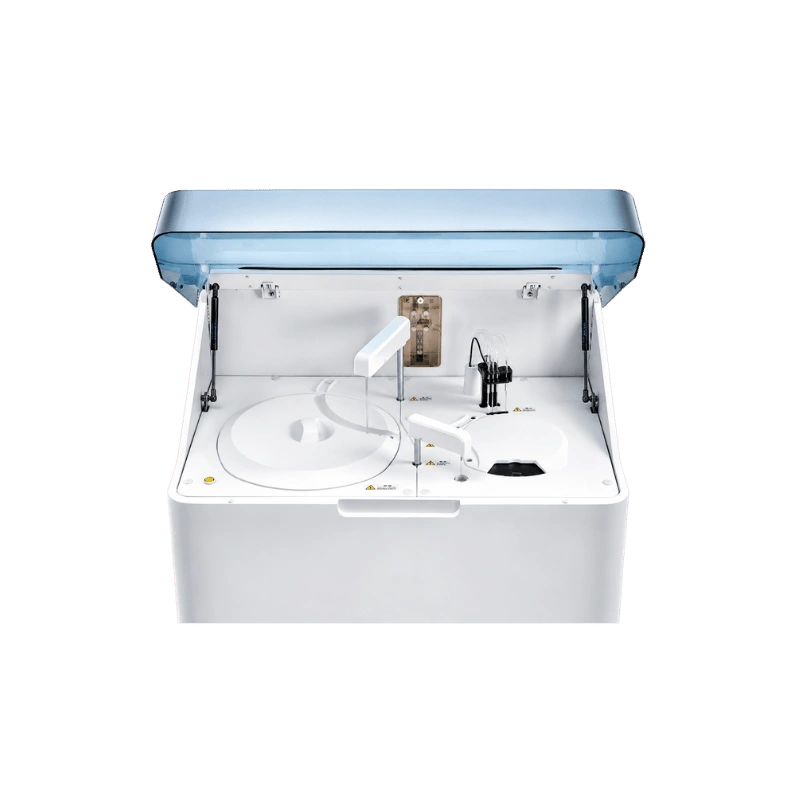
Labotemp Fully Automated Chemistry Analyzer LCA-201 is a high-throughput chemistry analyzer machine designed for routine clinical chemistry testing in diagnostic and laboratory settings. The system supports serum, plasma, urine, cerebrospinal fluid and whole blood for HbA1c testing, with a biochemical testing speed of up to 360 T/H and optional ISE throughput of up to 480 T/H. It can simultaneously analyze up to 103 projects, supporting a broad testing workload including liver and renal function, lipid profile, cardiovascular markers, glucose metabolism, pancreatic function, special proteins, rheumatic testing, anemia-related parameters and inorganic ions.
Designed for consistent and repeatable analysis, the clinical chemistry analyzer maintains the reaction vessel at 37±0.1°C and provides continuous reagent refrigeration at 2–12°C. Its optical system uses 12 detection wavelengths from 340 to 800 nm, while liquid-level detection, volume tracking, 3D anti-collision and intelligent full-needle cleaning support reliable sample handling. Sample volumes range from 2–35 μL, with dilution testing from 3 to 100 times, and sample-needle cross-contamination is specified at ≤0.05%. Automated reaction-cup cleaning, optimized mixing and a water consumption of ≤6.5 L/h further support practical long-term laboratory operation.
Why Choose Labotemp Fully Automated Chemistry Analyzer LCA-201?
✓ High Testing Throughput: Up to 360 T/H biochemical testing with optional ISE capability up to 480 T/H.
✓ Stable Reaction Conditions: Maintains reaction temperature at 37±0.1°C with refrigerated reagents at 2–12°C.
✓ Reliable Sample Handling: Liquid-level detection, volume tracking, 3D anti-collision and full-needle cleaning help support consistent testing.
| No. | Specification | Value |
|---|---|---|
| General Specifications | ||
| 1 | Product Type | Fully Automated Chemistry Analyzer |
| 2 | Biochemical Module Throughput | Maximum 360 T/H |
| 3 | Simultaneous Analysis Projects | Up to 103 |
| 4 | Sample Types | Serum, Plasma, Urine, Cerebrospinal Fluid, Whole Blood (HbA1c) |
| Sample Unit | ||
| 5 | Sample Positions | 50–100 |
| 6 | Sample Volume | 2–35 μL |
| 7 | Sample Volume Increment | 0.1 μL |
| 8 | Sample Addition Technology | Liquid Level Detection, Volume Tracking, 3D Anti-Collision |
| 9 | Needle Blockage Detection | Optional |
| 10 | Needle Cleaning | Intelligent Full-Needle 3D Cleaning |
| 11 | Sample Dilution | Supported |
| 12 | Dilution Factor | 3–100 Times |
| 13 | Sample Needle Cross-Contamination Rate | ≤0.05% |
| Reagent & Reaction Unit | ||
| 14 | Reagent Positions | 50–100 |
| 15 | Reagent Refrigeration | 2–12°C, Continuous Refrigeration for 24 Hours |
| 16 | Reagent Volume | 10–200 μL |
| 17 | Reagent Volume Increment | 0.5 μL |
| 18 | Reaction Cups | 80 Special Optical Plastic Colorimetric Cups |
| 19 | Reaction Temperature | 37±0.1°C |
| 20 | Reaction Liquid Volume | 100–360 μL |
| 21 | Reaction Cup Cleaning | Cleaning Agent and Warm Water |
| Optical System | ||
| 22 | Illuminant | 12V, 20W Long-Life Halogen Tungsten Lamp |
| 23 | Lamp Service Life | 2000 H |
| 24 | Beam Splitting Method | Post-Holographic Concave Grating Beam Splitting System |
| 25 | Detection Wavelengths | 340 nm, 380 nm, 412 nm, 450 nm, 505 nm, 546 nm, 570 nm, 605 nm, 660 nm, 700 nm, 740 nm, 800 nm |
| 26 | Number of Detection Wavelengths | 12 |
| 27 | Absorbance Range | 0–3.5 A |
| 28 | Stray Light | Absorbance should be not less than 4.9 |
| Electrical, Environmental & Physical Specifications | ||
| 29 | Power Supply | 100V–240V, 50/60 Hz |
| 30 | Ambient Temperature | 15–30°C |
| 31 | Operating Altitude | -400 m–2000 m |
| 32 | Water Consumption | ≤6.5 L/h |
| 33 | Main Unit Dimensions (L × W × H) | 860 × 660 × 920 mm |
| 34 | Gross Weight | 202 Kg |
| 35 | Volumetric Weight | 1.4 m³ |
Clinical Chemistry Testing: Supports routine biochemical testing of patient samples including serum, plasma, urine and cerebrospinal fluid.
Liver Function Analysis: Used for biochemical assessment of liver-related parameters such as ALT, AST, ALP, bilirubin and albumin.
Renal Function Testing: Supports analysis of kidney-related parameters including urea, creatinine, cystatin C and microalbumin.
Lipid Profile Testing: Used for measurement of lipid and lipoprotein parameters including total cholesterol, triglycerides, HDL-C and LDL-C.
Cardiovascular Testing: Supports biochemical testing of cardiovascular-related markers such as CK, CK-MB, LDH, hs-CRP and related parameters.
Glucose Metabolism Testing: Used for analysis of glucose metabolism parameters including glucose, HbA1c and β-HB.
Pancreatic Function Testing: Supports biochemical analysis of pancreatic-related parameters including α-amylase and lipase.
Special Protein Testing: Used for analysis of special proteins including C3, C4, IgG, IgA and IgM.
Rheumatic Testing: Supports testing of rheumatic-related markers including CRP, ASO II and RF II.
Anemia-Related Testing: Used for analysis of iron and related parameters including Fe, ferritin, transferrin and UIBC.
Inorganic Ion Testing: Supports analysis of inorganic ions including calcium, phosphorus, magnesium, CO₂, sodium, potassium and chloride.
Whole-Blood HbA1c Testing: Supports automated HbA1c analysis from whole-blood samples with direct NGSP or IFCC result output.
